RIDING ADVICE / ARTICLE
Motorcycle Riding Drills: A Guide to Core Skills Practice
Plan motorcycle skills practice with primary training resources, clear limits for braking and turning, and guidance on when to work with an instructor.
Motorcycle riding drills should reinforce skills you have learned with an instructor. They cannot prepare you for every road hazard or guarantee that you will avoid a crash. Start with a clear practice objective, such as a smoother ordinary stop, rather than a target speed or lean angle.
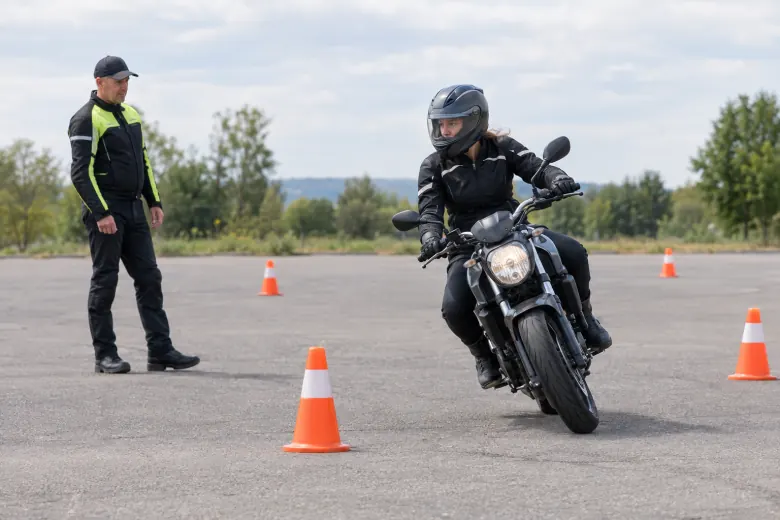
New to riding? Start with qualified instruction. The MSF Basic RiderCourse teaches foundational motorcycle control through classroom learning and supervised riding. Ask your local training provider which course fits your experience, motorcycle and licensing requirements. A friend watching you practise is not a substitute for an instructor teaching a new skill.
Prepare before practising
Use the MSF practice guide only after you can operate the clutch and throttle, shift and ride straight. Read its complete setup and diagrams first. Obtain permission for an off-street practice area; check for traffic, pedestrians, gravel, oil and other hazards. Wear a helmet, eye protection, gloves, protective riding clothes and over-ankle footwear. Stop when tired.
Inspect your motorcycle using its owner’s manual and the MSF T-CLOCS checklist: tyres and wheels, controls, lights and electrics, fluids, chassis and stands. Resolve defects before riding. The manual supplies your bike’s settings and explains its braking system, including any ABS or linked brakes.
Choose a published exercise
The table points to three exercises in MSF’s guide. It is a reading plan, not the complete riding instructions. Follow the source’s layout and limits; if you cannot provide the required space or understand the exercise, book supervised practice.
| Practice objective | Exercise to read | What to review |
|---|---|---|
| Smooth ordinary stops | Exercise 1: straight-line stopping | A straight path, eyes up and coordinated controls without skidding. |
| Consistent corner preparation | Exercise 4: basic turns | Speed adjustment before the turn and looking through it. |
| Low-speed turning control | Exercise 6: sharp turns | Coordinating your view, steering, clutch and throttle. |
Braking and steering points to get right
Braking practice is not an invitation to lock a wheel. MSF explicitly cautions against front-wheel lock in its emergency-braking guidance, printed page 35.
Transport for NSW describes braking as an initial light application followed by a progressive increase in pressure; abrupt or excessive input can cause a skid. Its steering guidance distinguishes very slow direct steering from countersteering: forward pressure on the left handgrip initiates a left turn, and vice versa. That distinction matters when discussing parking manoeuvres versus riding through a curve. See the Motorcycle Rider Handbook, printed pages 58–59.
If braking or steering feels unpredictable, stop the exercise and have a qualified instructor assess your technique and the motorcycle’s suitability. Do not make the course tighter or ride faster to force improvement.
Take emergency and advanced skills to an instructor
For quick stops, swerving, braking in curves or unfamiliar terrain, ask a qualified rider-training provider for supervised instruction. Do not improvise a last-second obstacle challenge, intentionally lose traction, or attempt to practise recovering from a crash. Wheelies, stoppies and knee dragging are not part of this road-skills practice guide.
MSF’s DIY Practice Drills distinguish refreshing core skills from learning new skills through advanced training. Use that resource to review an exercise with your instructor and choose the next appropriate course. Confidence alone is not evidence that you are ready for a harder exercise.
Editorial update — 10 October 2026: This guide replaces an earlier list of 19 drills that included unsuitable stunt and crash-practice advice. The linked primary training sources were checked on this date. This is a research-based guide to training resources, not an account of exercises tested by XpertRider.
Published
Explore more riding advice
KEEP EXPLORING
More for your next ride

Riding advice Guide
How to Avoid a Sore Bum When Riding a Motorcycle
Troubleshoot motorcycle seat discomfort, compare air, gel and foam cushions, and check pad fit, mounting and rider reach before long rides.
Read guide
