MAINTENANCE / GUIDE
Motorcycle Winter Storage Checklist
Plan motorcycle winter storage around your owner's manual: fuel and stabilizer, battery chemistry, tires, engine care and checks before riding again.
Motorcycle Winter Storage Checklist
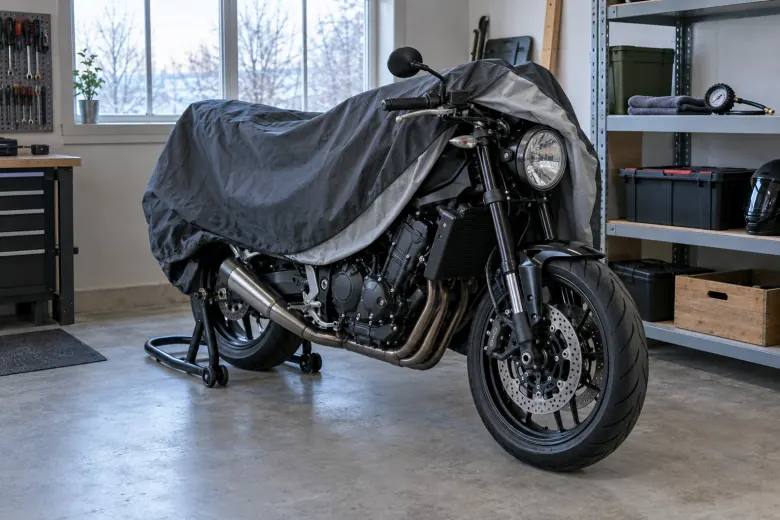
Start with the storage section of the owner’s manual for your motorcycle’s exact model, year and market. Record how long you expect to store it, then check the instructions for its installed battery and any storage products. A checklist helps organize those instructions; it cannot supply one fuel, charging or lifting procedure for every motorcycle.
Fuel stabilizer is a measured additive to fuel, not a replacement tankful. Do not drain the tank and refill it with stabilizer. The fuel section below explains what the cited instructions actually require.
Research scope: Primary manufacturer and Motorcycle Safety Foundation guidance reviewed on 13 October 2026. This guide does not report hands-on storage testing. The named manuals and products are examples, not proof of suitability for another bike or battery. If instructions are missing or conflict, ask the relevant manufacturer or a qualified technician before proceeding.
Cleaning and inspecting your motorcycle
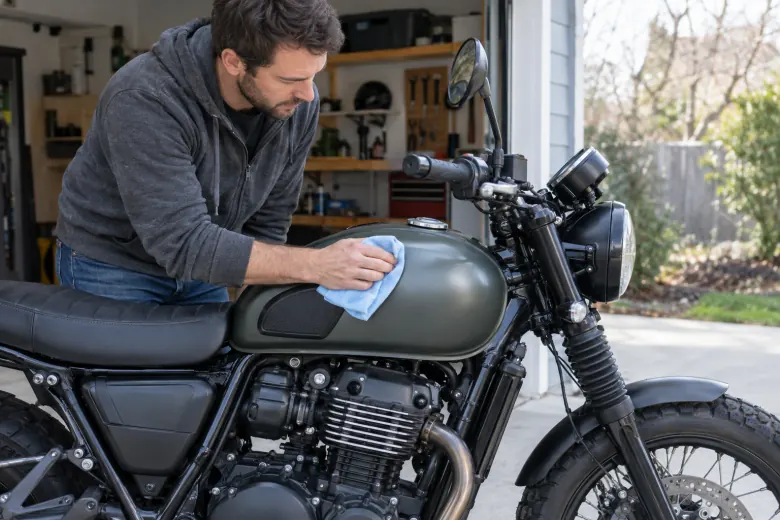
Use your manual’s cleaning and lubrication procedures, including its restrictions for finishes, seals and drive components. For example, the 2025 Honda CRF50F owner’s manual, 31GJGA70, describes gentle washing after cooling, drying and chain lubrication, with inspection for damage and leaks. This off-road model’s procedure is not a specification for every bike. Honda appearance care, printed 108–110.
Record faults and arrange repairs before storage. Keep protective oil and wax off brakes and tires, as emphasized in the Yamaha care precautions, printed 7-3.
Motorcycle winter storage checklist

Use this as a record of decisions made from your own instructions:
- Manual and duration: note the applicable edition, planned return date and required storage/service work.
- Fuel: record the specified tank level, fuel type and any treatment’s exact dose and date.
- Cleaning: complete the approved cleaning, drying and lubrication work.
- Battery: identify chemistry and model; record the approved storage location, charge checks and charging method.
- Tires and support: note specified pressures and the approved parking, support or wheel-movement method.
- Engine: complete only the storage procedures specified for this motorcycle, using professional help where needed.
- Return to service: list everything disconnected, removed or covered, plus checks and repairs required before riding.
The sections below explain the decisions behind this checklist.
Fuel: tank level, stabilizer dose and storage length
The Yamaha MT-03/MTN320-A manual B9A-F8199-E0, first edition June 2017, specifies filling the tank with fuel and adding stabilizer, if available, for several months’ storage (printed 7-4). Its filling limit is the bottom of the filler tube (3-16). These are model-specific instructions. Yamaha storage, refueling.
For a dosing example, Gold Eagle’s STA-BIL Storage directions specify 30 mL per 9.5 L of fuel (listed as 1 ounce per 2½ US gallons), using fresh fuel. The page describes storage of 30 days or longer and claims protection for up to 24 months, dependent on fuel and storage conditions. It also says the additive does not restore old gasoline. These are manufacturer claims for this formulation, not a guaranteed storage life. STA-BIL Storage directions and FAQs.
Read the current label on the exact bottle. Measure for the actual quantity of fuel being treated, not simply the tank’s advertised capacity. Do not transfer this dose to another formulation. The product’s suggested fill percentage does not override the motorcycle’s maximum fuel level; resolve any conflict with the manufacturers.
The same STA-BIL directions include a five-minute engine run to circulate treatment. This is a product-specific preparation step, not a weekly storage routine. If required and compatible with your motorcycle’s instructions, complete it outdoors where exhaust cannot accumulate or enter a building, before parking for storage.
Carburetor work is a separate question. The 2025 Honda CRF50F manual specifies a filled tank, fuel valve off and carburetor draining, particularly beyond one month. Draining a carburetor is not draining the tank. Use the complete model procedure or a technician; cleaning jets is not a universal winter task. Honda requires outdoor fuel handling with the engine stopped and ignition sources kept away. Honda storage preparation, printed 117.
Parked storage indoors and running an engine are different
A garage may be suitable for parking with the engine off. The cited Honda manual specifies an unheated, dry area with limited temperature variation and a porous cover (printed 118). An unheated building is therefore not automatically unsuitable; check your motorcycle, battery and tire requirements against the conditions you actually have. Honda storage location.
Let the bike dry and engine/exhaust cool before covering; Yamaha warns against trapped moisture. For outdoor storage, assess weather exposure and the cover’s instructions rather than assuming any waterproof sheet is suitable. Yamaha storage precautions, printed 7-4.
Never run the engine indoors or in a poorly ventilated or partly enclosed space. Open doors or fans are insufficient. Outdoors, prevent exhaust entering buildings. Yamaha’s warning concerns engine operation, not parked storage. Yamaha carbon-monoxide warning, printed 1-3.
Battery storage depends on chemistry and model
Identify the battery actually installed, including any replacement or lithium conversion. Use its instructions together with the motorcycle manual to decide whether to disconnect or remove it, where to store it, and when to check its charge. Storage-temperature limits and permitted charging temperatures are separate checks.
- Conventional lead-acid and AGM: Yuasa’s storage guide calls for an approved full charge and disconnection from vehicle loads. It lists monthly checks for conventional batteries and three-monthly checks for AGM, with more frequent AGM checks in hotter storage. These are Yuasa’s general intervals; a more specific battery or motorcycle instruction may require earlier attention. Activated AGM batteries stay sealed; do not add water. Yuasa storage guidance.
- Lithium: use the exact battery maker’s instructions, including its battery management system (BMS) requirements. For example, Shorai prohibits the BMS01 charger’s STORE mode for its batteries with an internal BMS and says not to leave lead-acid chargers connected for storage. Its charging guidance requires temperatures above freezing. Those restrictions are specific to Shorai, not a specification for every lithium battery. Shorai FAQ, charging guidance.
A cover or insulation does not establish acceptable battery temperature or charging compatibility. Before connecting a charger, use our motorcycle battery maintainer and trickle-charger guide to check chemistry, voltage, current, mode and monitoring requirements. “Automatic” does not mean compatible with every battery or suitable for unattended use.
Engine storage: avoid improvised routines

Do not assume every motorcycle needs fogging oil, an extra tank corrosion treatment, carburetor dismantling or periodic starting. Find the applicable engine-preservation and return-to-service instructions first.
The cited Yamaha manual includes cylinder protection with spark precautions (printed 7-4–7-5). Use its complete procedure or a qualified technician; do not generalize it into spraying oil into any engine. Yamaha long-term storage.
Put any required oil, coolant or other service on your checklist using the actual maintenance schedule and fluid specifications. A calendar reminder should prompt the specified inspection or charge check, not an invented engine-running routine.
Tires and supporting the motorcycle
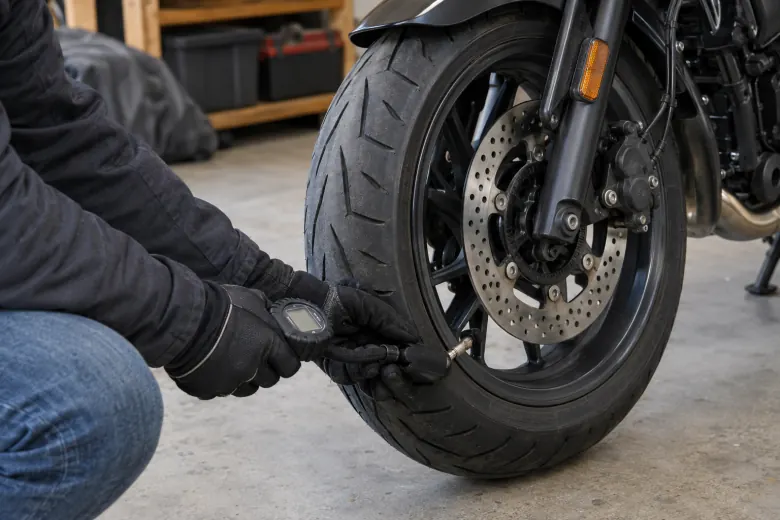
Use the motorcycle’s specified pressures and any applicable storage instructions. Michelin directs riders to the manufacturer’s cold-pressure specification, not the tire sidewall maximum, and says nitrogen-filled tires still need pressure checks. There is no reason to replace a pressure check with an assumption that nitrogen will maintain it. Michelin pressure guidance.
For this MT-03 edition, Yamaha allows wheels supported off the ground or monthly wheel movement (printed 7-5). Use support equipment and contact points approved for your motorcycle; a photograph of a paddock stand does not establish fit. If you cannot confirm a stable method, ask a technician rather than improvise a jack location. Yamaha storage, support precautions, printed 6-35.
Check the bike before riding again
Work through your manual’s return-to-service instructions and the record you made before storage. Account for every disconnected component or temporary cover before attempting to start the engine.
The Motorcycle Safety Foundation’s T-CLOCS inspection checklist provides a useful reminder of the areas to inspect:
- Tires, wheels and brakes: pressure, condition, wear and brake operation.
- Controls: free movement, cables and hoses.
- Lights and electrics: battery connections, lights, switches and wiring.
- Oil and other fluids: specified levels and signs of leaks.
- Chassis and drive: condition, fasteners and applicable chain or belt checks.
- Stands: condition and retention.
Use your motorcycle’s procedures and limits for those checks. Starting successfully does not establish that the bike is ready to ride. Resolve leaks, damaged tires, brake problems or other faults before returning it to use; seek qualified help for checks or repairs beyond your skills.
Published
Explore more maintenance
KEEP EXPLORING
More for your next ride

Maintenance Guide
Kickstand Safety Switch Problems: Diagnosis and Repair
A neutral start with the kickstand down can be normal. Understand model-specific interlock behavior, fault observations and when to arrange repair.
Read guide
Maintenance Guide
Motorcycle Neutral Safety Switch: Diagnosis and Repair
Understand neutral, clutch and sidestand interlock symptoms, check the correct model manual, and prepare for repair without bypassing the system.
Read guide